
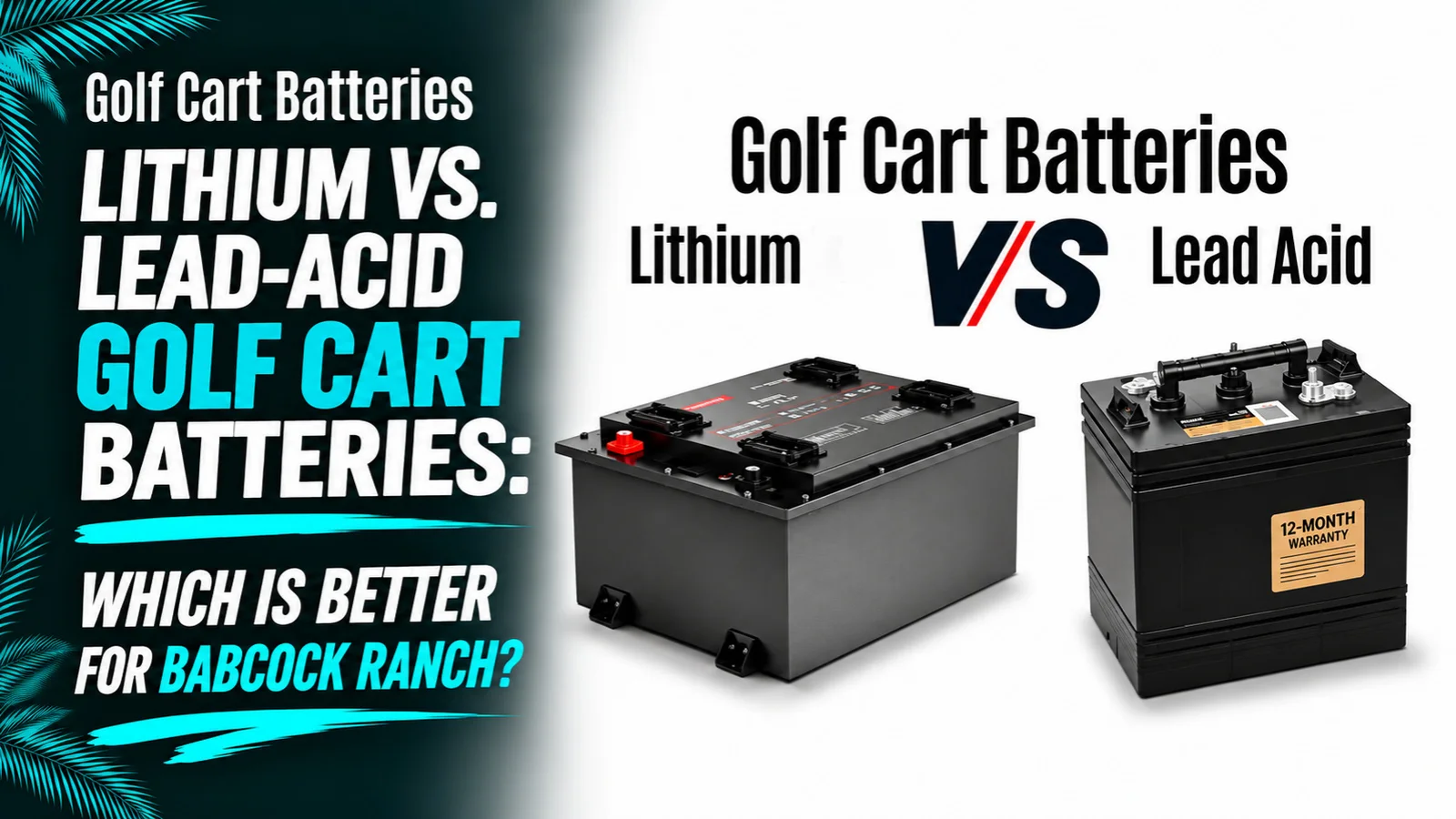
If you’re comparing a lithium golf cart battery with a traditional lead-acid battery, you’ve probably heard some strong opinions. Lithium is lighter, newer, and easier to maintain. Lead-acid costs less upfront and has powered golf carts for generations. So which is actually better?
Here in Babcock Ranch, that question has practical consequences. Your golf cart might take you to Founder’s Square for dinner, across the neighborhood to see friends, or out for another quick trip after you thought you were home for the evening. For many residents, the golf cart isn’t an occasional toy. It’s one of the most convenient ways to enjoy everyday life on the Ranch.
The right battery depends on how often you drive, the cart you own, how long you plan to keep it, and how much maintenance you want to handle. In this guide, we’ll look at the real differences in charging, range, weight, lifespan, and cost. We’ll also look at when a lithium upgrade makes sense, and when keeping a healthy lead-acid system may be the better decision.
Understanding the differences between golf cart batteries can help you make a smarter investment. Whether you choose lithium or lead-acid, the right battery system should match your driving habits, performance expectations, and long-term maintenance preferences.
What’s the Difference Between Lithium and Lead-Acid Golf Cart Batteries?
Both battery types do the same basic job: they store electrical energy and supply power to your golf cart’s motor and accessories. But the way they store that energy, the amount of maintenance they need, and how they behave as they discharge can be quite different.
Choosing the right golf cart batteries is an important part of getting the most out of your vehicle. The best golf cart batteries should match your daily driving habits, performance expectations, and long-term ownership plans.
Lead-acid: the familiar, proven option
Traditional golf cart batteries can be a practical choice for owners who prioritize affordability and familiar maintenance routines. For many residents, golf cart batteries with a lower initial purchase price may be enough to meet their everyday transportation needs.
Many older electric golf carts use a group of six-volt, eight-volt, or twelve-volt lead-acid batteries connected to create the cart’s required system voltage. Flooded lead-acid batteries contain liquid electrolyte and need regular inspection, proper charging, and periodic watering with distilled water. Not every lead-acid battery is flooded; sealed AGM designs are also available and have different maintenance requirements.
When comparing golf cart batteries, understanding the differences between battery technologies can help you avoid unnecessary expenses. Different golf cart batteries offer different advantages depending on capacity, maintenance, and charging requirements.
The appeal is straightforward. Lead-acid is familiar, replacement options are widely understood, and the initial purchase price is generally lower than a comparable lithium setup. If your cart is already working well and you’re comfortable with its maintenance needs, there may be no urgent reason to change.
But there’s a definite tradeoff: these batteries typically require a lot of attention. Flooded packs need correct watering, clean terminals, and consistent charging. Leaving them undercharged or storing them in poor conditions can shorten their useful life. For residents who spend part of the year away from Babcock Ranch, golf cart battery care during long periods of inactivity is especially important.
Lithium: more usable energy with less routine upkeep
Modern golf cart batteries offer additional convenience through improved energy management and reduced routine maintenance. Lithium golf cart batteries are particularly attractive to drivers who want a lighter system and fewer maintenance tasks.
Lithium golf cart batteries commonly use lithium iron phosphate chemistry, often called LiFePO4 or LFP. These systems are generally lighter than comparable lead-acid packs and do not need the periodic watering required by flooded lead-acid batteries. Many also include a battery management system, or BMS, to monitor cell conditions and provide protective functions.
The BMS is important, but it is not a reason to ignore installation and charging instructions. Battery protection features, charger compatibility, current limits, and operating temperature ranges depend on the specific product. Not every lithium battery is designed for every golf cart.
In practical terms, lithium can feel like a convenience upgrade. You spend less time thinking about watering and routine battery upkeep, and more time using the cart. But lithium typically requires a larger upfront investment, and the installation needs to be matched to the vehicle.
When comparing golf cart batteries, it is important to consider more than the initial purchase price. Battery capacity, charging requirements, expected lifespan, and compatibility with your golf cart all play an important role in choosing the right system.
Lithium vs. Lead-Acid: Range, Charging, Weight, and Performance
A golf cart battery comparison becomes much more useful when you connect the specifications to what driving feels like. Most buyers don’t need to memorize amp-hours, voltage curves, or charge profiles. However, they DO need to understand what those things may mean for a regular afternoon driving your golf cart in Babcock Ranch.
Range is about usable capacity, not just a battery label
Lithium batteries can often deliver a greater share of their stored energy within the manufacturer’s recommended operating limits. Lead-acid batteries tend to have more noticeable voltage drop as they discharge, particularly under heavier loads. That can affect how consistently the cart feels as the charge level falls.
However, a lithium label does not automatically mean more miles. The usable capacity of the actual pack matters. So do motor efficiency, tire size and pressure, passenger weight, accessories, speed, driving habits, and the condition of the rest of the cart. A small lithium pack may provide less real-world range than a larger, healthy lead-acid pack.
For a buyer comparing electric golf carts for sale in Babcock Ranch (or anywhere else), make sure you ask about the battery’s usable capacity and a realistic driving-range estimate based on the exact cart and configuration. If someone quotes a range number, ask under what conditions it was measured. A cart carrying two adults on mostly level roads can behave differently from one carrying six people with a cooler and extra equipment.
Charging convenience depends on the charger and battery
Charging habits can influence the long-term performance of golf cart batteries. Following the manufacturer’s recommendations helps golf cart batteries operate within their intended charging and storage conditions.
Many lithium systems support faster charging than traditional flooded lead-acid setups, but actual charging time depends on the battery’s capacity, the charger’s output, and the limits specified by the manufacturer. It’s a mistake to assume every lithium battery charges in a certain number of hours.
Flooded lead-acid batteries typically benefit from being recharged after use and from avoiding long periods in a partially discharged state. Lithium owners should follow their battery manufacturer’s charging and storage guidance rather than copying lead-acid habits automatically. Different chemistry means different instructions.
For example, imagine you take your golf cart out in the morning, return home for lunch, and head back out for dinner. A system that recharges more quickly between trips may have real value. If you usually take short rides and can charge overnight, the difference may matter less.
Lower battery weight can change the driving experience
A lithium battery system is generally lighter than a lead-acid pack with similar intended energy use. Removing weight can help a cart feel more responsive and reduce the load the vehicle carries. But the size of that improvement depends on the original battery pack, the replacement system, and the cart itself.
Weight should never be the sole reason for a conversion. Getting a properly sized, securely installed battery system that matches the cart’s electrical requirements is more important than achieving the lowest possible number on a scale.
Here’s a useful way to compare the two technologies:
• Upfront price: Lead-acid often wins. Lithium generally costs more initially.
• Routine maintenance: Lithium usually wins over flooded lead-acid because it does not require watering.
• Weight: Lithium generally provides a meaningful reduction.
• Charging speed: Lithium may offer an advantage when the complete battery-and-charger system supports it.
• Longevity: Lithium can offer more charge cycles, but real service life depends on the exact product, usage, climate, and care.
• Simplicity of replacing an existing pack: Lead-acid may be easier when you are replacing like-for-like; lithium requires an electrical compatibility review.
Which Battery Costs Less Over the Life of Your Golf Cart?
This is where the comparison gets interesting. A lithium golf cart battery usually requires more money at the beginning. That can be a hard number to overlook when a lead-acid replacement appears much less expensive. But remember, purchase price and long-term ownership cost are not the same thing.
The long-term value of golf cart batteries depends on how frequently you use your cart, how well the batteries are maintained, and how many years you expect to keep the vehicle. Looking at the total cost of ownership can help you make a more informed decision.
Lead-acid owners may face periodic watering, cleaning, inspections, and eventually battery replacement. Lithium systems can reduce some of that ongoing maintenance and may last through more charge cycles when properly selected and used. Whether that saves enough money to justify the purchase depends on how much you drive and how long you keep the cart.
Avoid relying on blanket claims like “lithium lasts twice as long” or “lead-acid always needs replacing after a certain number of years.” The manufacturer, capacity, depth of discharge, charging practices, temperature, and battery condition all affect the outcome. Realistic estimates are more useful than a one-size-fits-all promise.
Think in years of ownership, not just today’s invoice
The long-term cost of golf cart batteries should include installation, maintenance, replacement, and warranty coverage. Evaluating these factors makes it easier to compare golf cart batteries based on their actual ownership costs.
Suppose one homeowner plans to keep a cart for eight or ten years and drives it almost every day. Another expects to sell a cart in a year or two and only drives a few times each month. Even if both buyers are looking at the exact same battery options, the financial decision may be different.
The everyday rider might place a higher value on less maintenance, charging convenience, and long-term cycle life. The occasional rider might prefer to avoid a large upgrade expense if the existing lead-acid batteries are healthy and the cart already meets their needs. The key is comparing the complete cost over the years you actually expect to own the cart.
Ask for an itemized quote that includes the battery system, approved charger if needed, installation, any wiring or accessory changes, warranty coverage, and expected maintenance. If you are evaluating a new cart, compare the complete vehicle price with each battery option rather than treating the battery as a separate purchase.
A battery’s warranty tells only part of the story
Two batteries may advertise warranties of similar length while covering different failures, labor costs, transfer conditions, or levels of remaining capacity. Make sure to ask what the warranty actually promises, how claims are handled, and whether the installer or dealer can help if a problem appears.
Local support matters too. A great-looking warranty is less reassuring if you are unsure who will diagnose a problem or how long a replacement part could take to arrive. Here in Babcock Ranch, being able to talk with a service team right here in town is part of the ownership experience, not just a convenience during the sale.
An important reminder: the most expensive battery is not necessarily the best battery for your cart. Paying for capacity you will rarely use can be just as unnecessary as choosing a pack that is too small for the way you drive.
Which Battery Fits Your Babcock Ranch Lifestyle?
Rather than recommending one technology to every customer, we prefer to start with the way you actually use your cart. That is especially important in Babcock Ranch, where golf carts are part of neighborhood life and individual driving habits vary more than you might expect.
Your lifestyle should guide your decision when selecting golf cart batteries. Drivers who use their carts every day may prioritize different features than homeowners who only need golf cart batteries for occasional neighborhood trips.
The daily driver
If you take several trips around the Ranch most days, a properly sized lithium system deserves a close look. Reduced maintenance and convenient charging can become meaningful benefits over years of regular use. If your current lead-acid setup is aging anyway, it may also be an opportunity to compare replacement and conversion costs.
The occasional cruiser
If your cart mainly comes out for the occasional dinner, weekend ride, or neighborhood visit, a healthy lead-acid pack may do everything you need. There’s no need to replace a working battery system simply because newer technology is available. Put your money toward the things that genuinely improve your experience, like a good maintenance plan from a local golf cart shop who can help you get the most life out of the battery you already have.
The family or frequent guest host
A cart that frequently carries several passengers needs enough real-world range and power for its typical load. Battery capacity is important, but so are proper seating, braking, tires, and overall vehicle condition. A six-passenger cart doesn’t automatically require lithium, and lithium doesn’t automatically solve an undersized or poorly maintained vehicle.
The seasonal resident
If you spend part of the year away from Southwest Florida, storage instructions deserve extra attention. Flooded lead-acid batteries should not be left discharged and may need monitoring or maintenance during extended inactivity. Lithium batteries also have manufacturer-specific storage and state-of-charge recommendations. For either technology, a plan for safe storage and charging is more valuable than guessing.
Florida weather enters this decision as well. High heat can affect battery life, so storage conditions, airflow, charger placement, and manufacturer operating limits matter. Do not assume that a battery with fewer routine maintenance tasks is immune to the effects of our climate.
The useful question is not “Which battery is best in general?” It is “Which complete battery system is best for the way we use our cart, the way we store it, and the years we expect to own it?”
Can You Upgrade an Existing Golf Cart From Lead-Acid to Lithium?
In many cases, yes! Lithium battery conversions are available for a variety of golf carts. But a successful upgrade is more involved than just pulling the old batteries out and dropping a new one into the empty space. This is one of the biggest misconceptions we hear in battery discussions.
A good conversion starts with the vehicle’s electrical requirements and the battery manufacturer’s specifications. The nominal voltage has to be correct, the battery must be able to supply the current the cart demands, and the charger must use an approved profile. Physical fit, secure mounting, wiring, connections, monitoring, and accessories also matter.
Some carts also have a voltage reducer or other systems powering lights and accessories. Those components need to be evaluated as part of the conversion. That last thing you want is a new battery that solves one problem but introduces another.
Before upgrading your golf cart batteries, make sure the new system is compatible with your cart’s voltage, charger, and electrical components. A proper evaluation can help prevent installation issues and ensure reliable performance.
The manufacturer RELiON, for example, specifically recommends a charger with the appropriate lithium charge profile and identifies practical conversion considerations such as battery spacers, secure mounting, and compatible monitoring. That is why it makes sense to have a qualified golf cart technician review the entire system.
When upgrading may be worth it
A conversion may make sense when your existing lead-acid batteries are near replacement, the golf cart itself remains in good condition, and you expect to use it regularly for several more years. You would already need to spend money on batteries, so it becomes reasonable to compare the cost of another lead-acid pack with the installed cost of a properly matched lithium system.
When to keep the lead-acid system
If the existing batteries are healthy, your driving needs are modest, and you’re happy with the performance you’re getting, keeping your current battery system may be the better value. You can always revisit the lithium conversation when the batteries actually need replacement, and there’s nothing wrong with choosing proven technology that already works for your family.
If your cart is experiencing reduced range, unusual charging behavior, or intermittent power, start with a diagnosis before assuming it needs a new battery chemistry. A weak connection, charger problem, or another electrical issue can sometimes mimic a worn-out battery pack. Testing the system first can keep you from spending money on the wrong fix. That’s one reason it’s great to have a local shop where you can drive your cart up and get it checked out right away!
Choosing between lithium and lead-acid golf cart batteries ultimately comes down to your individual needs. Comparing available golf cart battery options with the help of an experienced local team can make the decision easier.
Let’s Find the Right Battery for Your Cart
At Solar City Carts, we live and work right here in Babcock Ranch. We know how often a golf cart becomes part of daily life, whether that means a quick stop at Founder’s Square, visiting friends, or heading out for an evening ride with the family.
If you’re comparing lithium and lead-acid golf cart batteries, we can help you understand the options for the cart you own or the new cart you’re considering. Our approach is simple: look at your driving habits, check the vehicle’s needs, compare the real costs, and make a recommendation that fits your situation. If there’s no good reason to replace a healthy battery, we’ll tell you that too.
When you’re ready to get your golf cart battery questions answered, just stop by Solar City Carts in Babcock Ranch, contact our local service team, or schedule a test drive to explore our electric golf cart options. The right choice should make life on the Ranch more convenient, reliable, and fun.
Frequently Asked Questions About Golf Cart Batteries
Are lithium golf cart batteries better than lead-acid?
Lithium can be a better fit for frequent drivers who value lower weight, less routine maintenance, and potentially faster charging. Lead-acid may be better for buyers prioritizing a lower upfront cost or keeping a healthy existing setup. Compare the complete battery system against your actual driving needs.
Do lithium golf cart batteries last longer?
Many lithium systems are designed for more charge cycles than traditional flooded lead-acid systems, but exact longevity depends on the specific battery, charging practices, depth of discharge, climate, and use. Compare written specifications and warranty terms instead of relying on a universal number of years.
Will a lithium battery make my golf cart go farther?
Possibly, but not automatically. Actual range depends on usable battery capacity and the cart’s efficiency, load, tires, speed, and driving conditions. A properly sized lithium system may improve practical range, but a small pack can still be too small for your needs.
Can I use my old charger after switching to lithium?
Do not assume that’s the case. Some chargers can be programmed to an approved lithium charge profile, but others can’t. Check the exact battery and charger manufacturer requirements before charging. A compatible charger is an important part of a safe, reliable conversion.
Do lithium golf cart batteries need maintenance?
While they generally don’t require the watering associated with flooded lead-acid batteries, they aren’t maintenance-free in every respect. Charging equipment, connections, mounting, monitoring, storage, and manufacturer instructions still matter.
Should I replace my lead-acid batteries before they fail?
Possibly, but not necessarily. If the batteries are healthy and give you the range and performance you need, replacement may be unnecessary. If their capacity is declining or problems are appearing, have the battery and charging system tested before deciding on a replacement or upgrade.
Can Solar City Carts help with golf cart battery questions in Babcock Ranch?
Yes! Our local team can help you discuss battery condition, compatibility, service needs, and the advantages of different electric golf cart options. Contact us or stop on by to ask about current battery services, replacement choices, and the best next step for your cart.